

How Union Contracts Protect and Empower Coffee Workers
As well as improved pay and benefits, a ratified union contract offers coffee workers power in an often-exploitative industry.
As well as improved pay and benefits, a ratified union contract offers coffee workers power in an often-exploitative industry.

For paid subscribers: The coffee industry is embracing automation, and consumers increasingly demand convenience and speed. Me? I’m happy to wait for my coffee to be made by a human.
Many people visit cafes during the workday—but for those who work nights, good coffee remains woefully scarce. Now, one enterprising Australian is trying to change that.

If you value independent coverage of the coffee industry, please consider becoming a paid subscriber to The Pourover:
Stopping at a coffee shop on the way to work is a daily ritual for many people. Others break up the day by nipping out for a latte, socialising around the office coffee machine, or holding meetings at a nearby cafe.
It’s hardly news that coffee is an important part of contemporary working life. In fact, one survey from 2023 found that the average person spends almost 50 hours each year visiting their local coffee shop during the workday. On the night shift, however, a good cup of coffee is harder to find—even as it takes on an arguably more essential function.
This isn’t a niche problem: Hundreds of millions of people around the world work overnight. Considering most cafes close in the late afternoon or early evening, that means the options for late-night coffee are typically limited to gas stations, convenience stores, or expensive delivery apps.
It’s true that the quality of convenience store coffee is improving, and those living in bigger U.S. cities might be lucky enough to have a late-closing Yemeni coffeehouse nearby. But amidst the other downsides of night-shift work—including worse physical and mental health outcomes—the lack of readily available coffee adds to the burden of such labour.
The situation can be especially frustrating for healthcare workers, who often aren’t able to leave hospital premises, even if there is a late-night cafe down the block. For a lucky few, however, the coffee can come to them. One enterprising Australian nurse recently set up a truck specifically to cater to his former night-shift hospital colleagues, addressing a demographic that few others have thought to prioritise.
Workers represent a significant, and largely untapped, market for coffee companies. Can the specialty coffee industry capitalise on that gap—and build a nighttime coffee economy that better serves all workers?
People have always worked at night, but the modern idea of shift work really began with the Industrial Revolution in the 18th century. Manufacturers saw the economic advantage of keeping their factories producing constantly, and had access to a growing labour pool of impoverished, often desperate people willing to work long hours.
Although working conditions have improved since then, many sectors—from manufacturing and construction to transport and health care—still run 24/7 operations in various forms. In industrialised countries, an estimated 15–20% of workers are employed in shift work, either overnight or with rotating day/night schedules. In the United Kingdom, 8.7 million people work overnight; in the United States, it’s more than 21 million; in the European Union, 29 million. There are more than 80 million shift workers in China.
As was true during the Industrial Revolution, the people who work nighttime jobs are often marginalised, and lack fair access to daytime employment options. In the U.S., as one 2025 study put it, “Persons without college degrees, racial/ethnic minorities, and persons experiencing poverty may be at a higher risk of engaging in non-day shifts due to the lack [of] opportunities and resources for career development”. In the U.K., a growing number of nighttime jobs are worked by migrants.
Long-term shift work, and especially overnight working, has consistently been shown to be detrimental to human health. Studies have charted multiple negative impacts, including increased risk of cardiovascular disease, gastrointestinal disorders, mental health issues, and diabetes. In 2007, the International Agency for Research on Cancer declared night-shift work to be a probable carcinogen, and it even has its own disorder. Shift Work Sleep Disorder is characterised by a combination of “excessive sleepiness during the desired waking period and/or insomnia when sleep is allowed”.
The reason why long-term overnight work is so detrimental to our health has a lot to do with our internal clock, or circadian rhythm, which governs our sleep and other body processes. Changes in sleep patterns and work schedules can disrupt these systems. “Our whole physiology is oriented to being asleep at night and awake during the day,” Harvard Medical School professor Jeanne F. Duffy told the New York Times in 2025. “So when you try to stay awake at night to work, you’re fighting this internal biology”.
Unsurprisingly, many overnight workers turn to caffeine to keep them sharp, both at work and during their non-work hours. Research has even shown that a coffee nap can help reduce “sleep inertia” in shift workers. But quality coffee options are hard to find late at night.
“You never know how tired or hungry you’re going to be, and eating or drinking just to stay awake is a real thing at night”, says Samantha Couvillion, a photographer and registered nurse in Michigan (and my wife’s college friend). Although she now works days, Couvillion had a long period of working the overnight shift. “DoorDash is more of a thing now than it was when I was on nights, but we’re still really limited as to what’s open at night in our small town”.
Couvillion says that, even as a self-professed night person, she only allowed herself a little coffee during her overnight shifts because of the effect it had on her sleep. And she always brought it with her, just because of the reality of working in healthcare. “We can’t leave the hospital at night”, she says. “There’s just not enough staff for us to take our breaks off campus”.
You're reading this, so chances are you enjoy The Pourover. If you know someone else who might enjoy it, why not tell them via email?
On the other side of the world, Gerome Creencia had a similar problem. An ICU nurse in Sydney, Australia, for 17 years, he found it near impossible to find a good cup of coffee while working nights. “You get free coffee at work, but that’s something that only resembles coffee”, he tells me. “Then your next option is the convenience store that has one of those automated machines, or you’re paying Uber Eats upwards of eight dollars for a lukewarm coffee”.
Still, Creencia enjoyed working nights, and when he left nursing in 2025 he decided he wanted to stay part of that community. As a night owl, and someone who intimately knows the difficulties of working nights, he saw it as an obvious decision to cater to overnight hospital staff. “I understand the night shift is not easy, but it never bothered me”, he says. To that end, he founded GW Barista, a coffee truck that tours Sydney’s hospitals through the night to serve specialty brews and pastries to healthcare workers.
His mission is about more than just providing necessary caffeine to tired workers, however. Coffee acts as both a physiological stimulant and a social connector within workplaces and beyond. One 2025 paper noted that the drink “serves as a multifaceted tool for mental health, offering emotional resilience, stress relief, and strengthened social connections through its rituals and cultural significance”.
This can be especially important for night workers, who often suffer from social isolation, as well as heightened levels of anxiety, stress, and depression. Creencia hopes to address some of those issues with his coffee truck. “I get workers coming either by themselves or with their workmates, and it’s a bit of respite, a five-minute break from the things that they’re dealing with in the hospital”, he says.
And it’s not just hospital staff. Creencia has started attracting other night workers, from paramedics to truck drivers. “I’m starting to see a lot more night-shift workers in general”, he says. “Word is slowly getting out, that there’s something available other than McDonald’s or convenience store coffee”.
This popularity has led Creencia to explore his expansion options, but GW Barista’s unique business model makes growth difficult. “Ideally I would love to own more trucks and service more areas, because there is definitely a market for it”, he says. However, hiring more staff is where the business runs into problems. “To be a barista on a night shift, it’s a tough ask”.
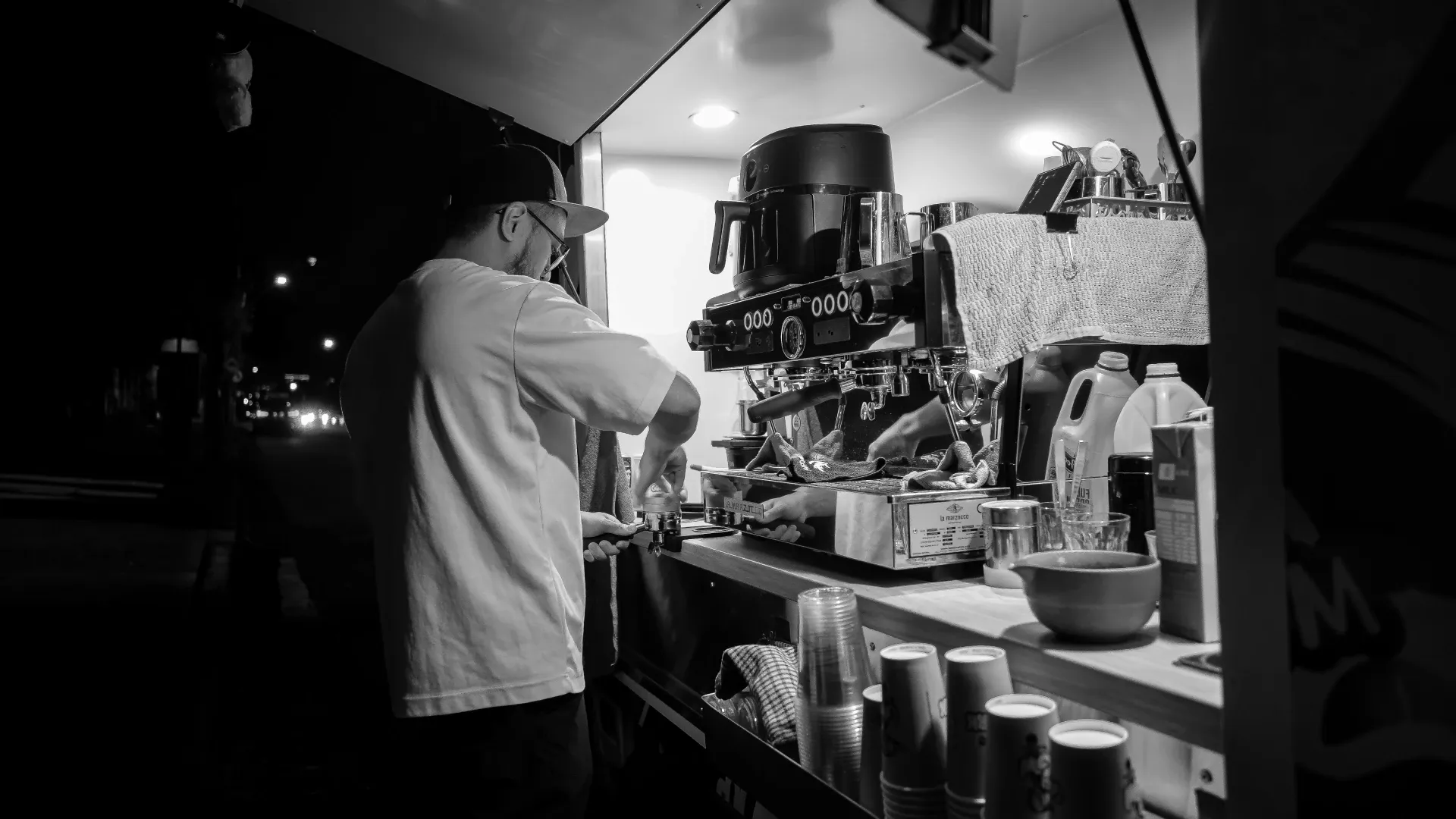
Creencia isn’t the only one trying to bring coffee to the night shift. Several coffee trucks in the U.S. have tried similar approaches, although many don’t last because of the unsociable hours.
One of the few still going ran into trouble in 2025 because a hospital deemed its branding offensive. Graveyard Shift Coffee had been serving coffee at the Mayo Clinic Hospital in Scottsdale, Arizona, when hospital officials banned the truck because its name, skeleton logo, and menu items such as “Bone Crusher” and “Murder Spice” were deemed too macabre.
“[It has] been the same for three and a half years, never been an issue before at any other hospital”, co-owner Tyler Tremaine told AZ Family. “We don’t have any bad intention with the name or the logo”, Sierra Tremaine said. “We just wanted the night-shift workers to feel seen”.
Although not specifically targeted at late-night workers, Starbucks launched a pilot with Gopuff to test 24-hour delivery in 2023. Using Gopuff’s “micro-fulfillment centers” in Philadelphia, “Starbucks-trained baristas” prepared drinks that were then delivered within 30 minutes. (Starbucks also runs a few 24-hour shops in New York City, within certain hospitals and casinos, and, weirdly, down the road from me in Perth, Scotland.)
After the pilot finished in 2024, Starbucks’ then-CEO Laxman Narasimhan declared it a success, saying it “doubled our business” and pledging to “aggressively [pursue] options to build a $2 billion business over the next five years”. However, Narasimhan was fired a few months later, and new CEO Brian Niccol immediately changed things up, promising to make the company “a welcoming coffeehouse” again. Among other things, this involved moving away from the former quick-service model that Narasimhan had implemented, including closing Starbucks’ small-footprint pickup-only stores.
Nonetheless, in 2025, Gopuff announced an expansion of its 24-hour Starbucks delivery service to more areas of Philadelphia. At the time, the city’s mayor, Cherelle Parker, said that “Having access to the Starbucks menu 24/7 is a big win, particularly for our students and third-shift workers”. It isn’t clear if this is a permanent service, or how it fits into Niccol’s wider Back to Starbucks plan—neither Starbucks nor Gopuff responded to requests for comment.
During Creencia’s time as a nurse, there were two previous coffee trucks that tried to corner the night-shift market at his hospital. However, “they don’t last long because the night shift just gets to them”, he says. “They do the night thing for about a year, and then I see them driving around during the day. It’s not for everybody”.
Night-shift workers are often treated as an afterthought, but they make up a significant portion of the population.
Spending your days asleep and your nights at work can take a toll, physically and mentally, and it means missing out on a lot of things the rest of us take for granted. For coffee lovers on the night shift, there are no midday cafe visits, no 50 hours a year spent recharging away from work. Instead, the options are largely limited to bringing extra coffee from home, or taking a risk on what Couvillion calls the “wheel of death” hospital vending machine.
Meanwhile, competition among coffee shops is increasing, and many established regions, like the U.S. and Europe, are becoming saturated. While big brands continue to expand, finding new, untapped markets will be key for those trying to compete. Overnight offers such a market, something that Starbucks noted after its pilot delivery project with Gopuff.
There are challenges, obviously. The inhospitable hours make hiring baristas tricky, while safety concerns would also need to be addressed. But they are not insurmountable: Coffee, while not lucrative, offers better wages than many industries where shift work is common, so convincing already-nocturnal workers to switch is at least feasible.
Based on the sheer number of shift workers around the world, Creencia’s booming business offers a template to other enterprising coffee entrepreneurs. It’s just a matter of embracing the night.
Thanks for reading! If you'd like to get even more articles like these, become a paid subscriber to The Pourover:

As well as improved pay and benefits, a ratified union contract offers coffee workers power in an often-exploitative industry.

Lucia Bawot’s initiative has helped more than 100 women coffee farmers in Colombia access mental health support. The programme’s success offers a blueprint for the wider coffee industry.

The release of millions of Jeffrey Epstein's emails uncovered volumes of sordid information. They also revealed more banal details—like his coffee habits.

Denver’s Amethyst Coffee closed in 2022, two years after raising prices to better compensate staff. But that doesn’t mean the project was a failure—in fact, it still offers lessons for the industry today.
Deeply researched articles exploring all the ways coffee connects to politics, history, and culture—delivered direct to your inbox