

The Coffee Industry Is Unequal. A Marxist Economic Theory Explains How.
Demand for coffee is growing, and climate change threatens supply—yet consumers don’t want to pay more. In an intensified and unequal industry, however, someone always pays.
Demand for coffee is growing, and climate change threatens supply—yet consumers don’t want to pay more. In an intensified and unequal industry, however, someone always pays.

For paid subscribers: One of Howard Schultz’ final acts as Starbucks CEO was inflicting upon us a line of olive oil-infused coffee drinks. He was so confident the Oleato would change the world. It didn’t.
Five favourite pieces from the past 12 months, plus some general thoughts about the newsletter.

As we all struggle to get back into swing of things, this first Pourover article of the year is once again going to be a retrospective. Last year was a particularly busy one for coffee (something I recently summarised in my Coffee News Recap for Fresh Cup Magazine) and also for this newsletter.
In 2025 I published 25 original longform articles and six Q&A interviews. I also started sending out fortnightly bonus articles to paid subscribers, which took the total number of published pieces to 50 over the course of the year. That seems about the right amount for what remains mostly a one person operation, although as always I must give a lot of credit to my editor, Claire, for consistently making me sound smarter than I am.
One of the reasons I enjoy writing this newsletter is that it allows me to cover any vaguely-coffee-related topic I am interested in, as well as topics that many other coffee publications won’t publish. Here, in no particular order, are five of my favourite articles from 2025, with a few extra thoughts on each one.
Thanks for reading The Pourover, and here's to another year of independent coffee coverage.
One of the more recent Pourover deep dives, this piece from November examines the growing popularity of regenerative agriculture.
It is obvious by now that the climate crisis is coming for coffee, and regenerative agriculture is being increasingly promoted as a solution—especially by big companies. However, questions remain over whether it can become anything more than another marketing buzzword, and I think it is necessary to continue having these conversations.
 Fionn Pooler
Occasionally I stumble across a theory, philosophical tenet, or another completely non-coffee-related concept that can, nonetheless, help explain some aspect of the industry. In 2024 I wrote several thousand words on how Stafford Beer’s heuristic “The purpose of a system is what it does” helps illuminate the coffee industry’s many contradictions.
Back in January, I wrote about a Microsoft business strategy from the 90s known as "Embrace, extend, and extinguish", and how it connected to Starbucks’ co-option of coffee drinks like the macchiato and cortado.
 Fionn Pooler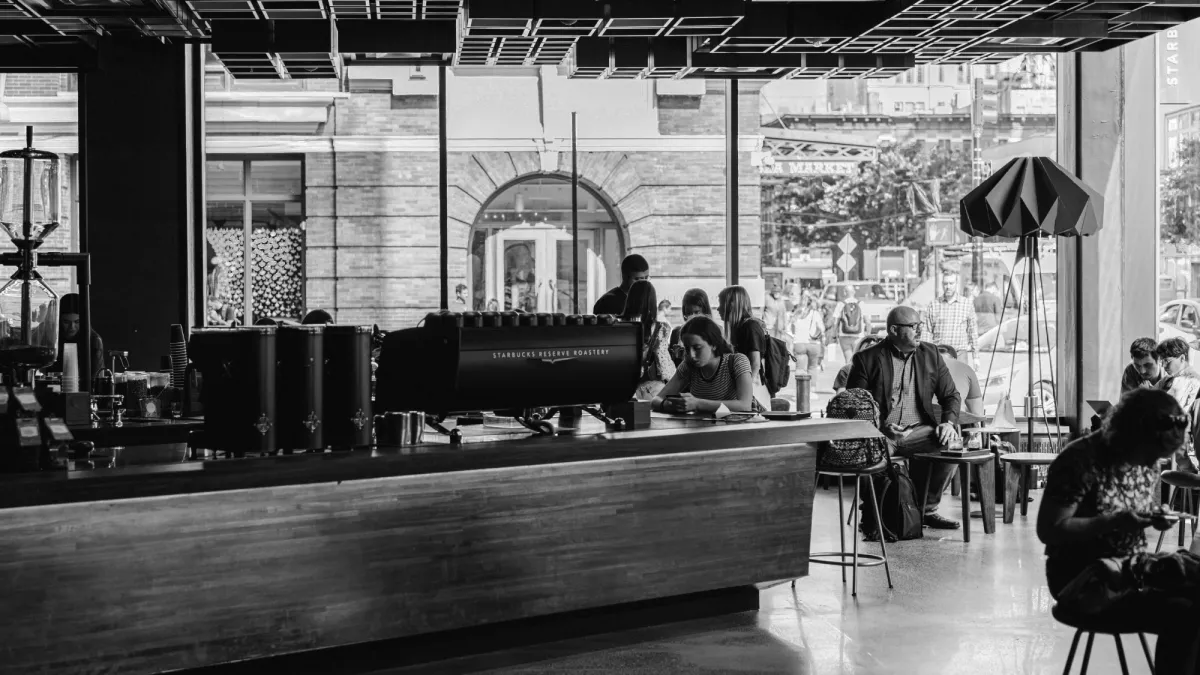
Because coffee is a globally-traded agricultural commodity, I end up covering politics a lot in this newsletter. This piece from July looked at how governments use coffee as a soft power tool, which makes sense when you consider coffee’s importance to many countries both economically and culturally.
Today, the U.S. remains the biggest coffee market in the world, and is still attractive by dint of its sheer buying power. But as the country withdraws from international aid projects and erects barriers to trade, why wouldn’t enterprising coffee farmers or exporters look for alternative markets? Meanwhile, China is ramping up imports to meet demand as it works to build soft power, something the U.S. seems keen to discard.
I also re-examined the concept of soft power later in the year when I looked at Dubai’s burgeoning coffee scene and all the ways the emirate’s government has tried to take advantage of that boom.
 Fionn Pooler
Another not-really-coffee-related concept, this time the French theorist Jean Baudrillard’s theories of simulacra and hyperreality. I connected these theories to the growing trend of venture capital-backed chains mimicking the aesthetics of specialty coffee to attract customers.
This article pretty much broke my brain during the research and writing phase, but because it was relatively well-accepted on the r/philosophy subreddit, I am going to assume it made sense.
 Fionn Pooler
I am very much against the use, acceptance, and promotion of generative AI. It is hugely harmful, these harms have been well-covered, and yet I continue to see companies and individuals in the coffee industry embracing it.
This piece outlines my objections.
If we cede the parts of the coffee process that involve expertise, dedication, and imagination—if we let plagiarism machines create blends and come up with products—then we might as well give up and allow the few multinationals that already dominate the industry to win outright.
 Fionn Pooler
Thanks for reading! If you'd like to receive all 50+ articles I publish in 2026—and support independent coffee writing—why not become a paid subscriber to The Pourover:

My five favourite Pourover pieces from last year, plus musings on the future of the newsletter.
Deeply researched articles exploring all the ways coffee connects to politics, history, and culture—delivered direct to your inbox